News Update :

Subscribe

Recommend on Google

Comments

Showing posts with label Earth. Show all posts

NASA Updates Us on Curiosity's Progress

Wednesday, August 15, 2012

It's been more than a week since NASA's Mars rover, dubbed "Curiosity," landed on the red planet. In that time, mission controllers at the agency's Jet Propulsion Laboratory (JPL) in Pasadena, Calif., have been checking Curiosity's 10 instruments and updating software for its two-year mission to look for evidence of microbial life on the planet. NASA held a news conference Tuesday to talk about Curiosity's progress so far.

Incredible Photos

Mars mission leaders showed magnificent images that have come in from Curiosity so far.

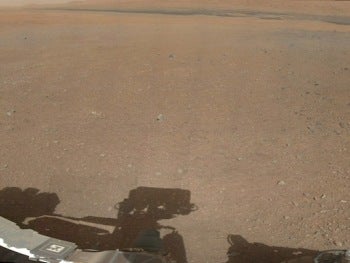
For instance, in this photo taken from one of the Rover's navigation cameras, you can see part of Curiosity's deck and power supply on the left, as well as both its low-gain and high-gain antennas which allow for communications between Curiosity, orbiting spacecraft and Earth. Farther out you can see the rim of Gale Crater. On the right, close to the rover, NASA says you can see where the descent stage's rocket engines blasted the ground before it disengaged and flew off to a crash landing.

If you were actually standing on Mars looking at this scene it would appear much different, NASA says. The sky there is red, and the dusty air and surface would make the view seem much blander. To make it easier for scientists to know what they're looking at, NASA has "white balanced" the colors to mimic what the rover would see if it were illuminated with Earth sunlight.
Next Steps
Over the next few days more images will come in from Curiosity, including better ones of Mount Sharp, which is where the rover is ultimately headed. According to Mars Mission Manager Mike Watkins, the panoramic images the rover has captured so far haven't shown a full sweep of Mount Sharp because, imaging sequences were pre-planned.
"We couldn't be sure that it would be safe to point [cameras] at the sun," Watkins said.
Starting today, weather instruments will start taking 24-hour measurements, although, because of the winds in the crater, it will take a while to sort it out the data.
In a couple of days NASA will begin testing steering actuators and will take Curiosity out for a short first drive--probably only about a few meters.
While NASA had already used data from the HIRISE (High Resolution Imaging Science Experiment) camera on NASA's Mars Reconnaissance Orbiter to identify about a half dozen of the best routes to Mount Sharp, now that the rover is on the ground it will be easier to determine which of those routes will be the safest to traverse in terms of rock size, sand depth, and inclines.
While Curiosity is capable of climbing rocks about a meter high and terrain that's sloped up to 50 degrees, Watkins said they will try to avoid going over high rocks or traveling on slopes angled more than 10 degrees.
NASA said it has commissioned all of Curiosity's instruments except the arm and drill, which will be done in about a week. After that, it will check out the arm joints—essentially doing some wake-up exercises--and even some drilling. So while "final characterization" is probably a month away, NASA says after next week Curiosity will have a lot of capability.

The Road To Mount Sharp

Getting to Mount Sharp, where Curiosity will be doing the bulk of its work, will take some time.
NASA says even though Curiosity's main goal is to study the lower sedimentary layers of Mount Sharp, it's important to understand the context around the area and, as such, will take two or three samples along the way there. Each time the Rover performs sampling it means a few weeks of activity in terms of finding the sample, deploying the arm, acquiring the sample and processing it in the lab.
Curiosity also has to contend with distance constraints. While Mount Sharp is only about 8km away from Curiosity's landing site as the crow flies, NASA says the rover will actually travel a few kilometers more because it will have to drive around obstacles.
The rover can only travel about 100 yards, or the length of a football field, each day. That means it will take around 100 days for the rover to get to Mount Sharp, sampling stops notwithstanding.

High Tech Avionics Were a Big Challenge

Curiosity got a "brain transplant" this weekend in which it received a new version of flight software that's better suited for working on the surface of Mars, such as driving and using Curiosity's powerful robotic arm and drill. It also gives the rover better image processing ability so it can avoid obstacles while driving as well as go on longer drives.
"I like to think of it as an intellectual upgrade, since the brain remains the same," said Avionics Systems Lead Jim Donaldson, who spent several minutes giving a jargon-filled description of what Curiosity's avionics do.
A photo of Gale CraterWhile no doubt an overgeneralization for a complicated piece of technology such as Curiosity, the avionics basically provide interfaces to instruments, radios, motors, and sensors. One of the biggest challenges engineers had to tackle, Donaldson said, involved "the scalability of existing design practices."
Translation: The Mars mission involves technology that is more complex than any other NASA has used.

A photo of Gale CraterHow to Keep up with Curiosity

NASA has dedicated an entire section of its website to its Mars mission and really everything you'd want to know about it is right there.
Otherwise, PCWorld's Ian Paul has put together a thorough guide on how to track the Mars rover using a plethora of online tools. Check out Mars Rover Curiosity: A Complete Guide to Tagging Along Online.

SpaceX mission: Just the beginning

Friday, May 25, 2012

SpaceX made history Friday as the first private company to successfully reach an orbiting space station - but its competitors aren't far behind.

Blue Origin, the commercial space outfit founded by Amazon.com's Jeff Bezos, has been wind-tunnel testing its Space Vehicle capsule, which is designed to carry up to seven astronauts to the International Space Station, much like SpaceX's Dragon capsule.

Another company, Sierra Nevada, is preparing to dangle a test version of its shuttle-like Dream Catcher from helicopters later this year to find out how well it slips through the air. The sleek spacecraft - which could lift off as soon as 2016 or 2017 - is designed to launch atop a powerful Atlas V rocket and then use its wings to fly back to Earth for a runway landing.

And a fourth private firm called Orbital Sciences Corp. is planning its first launch later in the year.

SpaceX's achievement crosses an important threshold in America's shift toward a commercially led space industry. The door is opening to cheaper, more efficient and easier access to orbit, say experts, at a time when American astronauts must hitch rides aboard Russian spacecraft.

Blue Origin tested its capsule last month in Dallas, confirming its ability to descend correctly through the atmosphere and to change its flight path, according to a Blue Origin statement.

Blue Origin's New Shepard rocket system is designed for vertical takeoff and landing. The spacecraft's liquid oxygen-liquid hydrogen rocket engine systems have been undergoing testing at NASA's Stennis Space Center in Mississippi, the company said.

It's been in business for only 12 years, and the company is already creating museum pieces - in this case an unmanned test vehicle called Charon.

Workers in Seattle moved the 9,500-pound machine into the Museum of Flight on Tuesday. Charon and its four powerful vertically set jet engines helped New Shepard engineers learn more about reusable booster rockets that blast off and land vertically.

"We've all seen cartoons of rockets landing vertically, and it really hasn't happened yet," museum President Douglas King said. "Figuring out how to do that in a way that's controllable and replicable is what this is all about."

Flying Charon by remote control "felt like trying to balance something on top of  a ball," King was told. "That's what Blue Origin is trying to learn to do: to fly a rocket booster back to the pad and then land it gently."

Sitting in the museum's Space Gallery, about 20 feet to the right of Charon, is a Russian Soyuz rocket capsule that flew to the space station in 2009.

"You think about this little tiny capsule as being all that returned from a big three-part spacecraft, and you get an idea how expensive spaceflight is and how we need to make access to space reasonable for a lot more people," King said. "You've got to make it reliable and affordable to do that."

The Dragon mission is beginning to demonstrate the exciting moment in history we're living in, he said.

"Things that used to only be accessible to a few carefully selected highly qualified right-stuff government employees are finally coming within reach of researchers, businesspeople and explorers," King said. "SpaceX deserves a lot of credit. That's an incredible achievement out there today - done only by governments before - and a lot of other people are going to follow."

See Original Article at lightyears.blogs.cnn.


Launch success for SpaceX mission

Tuesday, May 22, 2012

California's SpaceX has launched on a mission to re-supply the space station - the first cargo delivery to the orbiting outpost by a private company.
The firm's Falcon rocket, topped by an unmanned Dragon freight capsule, lifted clear of its Florida pad at 03:44 EDT (07:44 GMT; 08:44 BST).

The initial climb to an altitude some 340km above the Earth lasted a little under 10 minutes.

Within moments of being ejected, Dragon opened its solar panels.

It also unpacked its navigation equipment.

It will take a couple of days to reach the station. The plan currently is for the vessel to demonstrate its guidance, control and communications systems on Thursday, at a distance of 2.5km from the International Space Station (ISS).
Dragon Spacecraft annotated

If those practice proximity manoeuvres go well, Dragon will be allowed to drive to within 10m of the station on Friday. Astronauts inside the platform will then grab the ship with a robotic arm and berth it to the 400km-high structure.

They will empty Dragon of its 500kg of food, water and equipment, before releasing it for a return to Earth at the end of the month.

For Elon Musk, the CEO and chief designer at SpaceX, Tuesday's lift-off was a special moment.

"Every bit of adrenalin in my body released at that point," he told reporters. "There's so much hope riding on that rocket, so when it worked, and Dragon worked and the solar arrays deployed, [company employees] saw their handiwork in space and operating as it should - it was tremendous elation. It's like winning the Superbowl."

The mission has major significance because it marks a big change in the way the US wants to conduct its space operations.

Nasa is attempting to offload routine human spaceflight operations in low-Earth orbit to commercial industry in a way similar to how some large organisations contract out their IT or payroll.

The carriage of freight will be the first service to be bought in from external suppliers; the transport of astronauts to and from the station will be the second, later this decade.

The US space agency hopes these changes will save it money that can then be invested in exploration missions far beyond Earth, at destinations such as asteroids and Mars.
SpaceX mission control SpaceX mission control celebrates a successful ascent to orbit for Falcon and Dragon

"Although there's a lot ahead to complete this mission, we're certainly off to a good start," Charles Bolden, the Nasa administrator, told reporters.

"It's a great day for America… It's actually a great day for the world. There are people who thought we'd gone away, and today says we've not gone away at all," he said, alluding to the retirement of the agency's space shuttles last year.

SpaceX has many new systems it has to demonstrate in the coming days, and has tried to lower expectations ahead of the mission, repeating often that its aim is to learn things it did not previously know.

Nasa has set the California company a series of development milestones. Only when those have been met fully will a $1.6bn ISS re-supply contract kick in.

The agency is also looking to engage a second cargo partner. Orbital Sciences Corporation of Virginia is slightly behind SpaceX in its development schedule, although it started work on its Antares rocket and Cygnus capsule system later. Orbital expects to fly a first mission to the vicinity of the ISS later this year or early in 2013.

"We're really at the dawn of a new era in space exploration, and one where there's a much bigger role for commercial space companies," Mr Musk said.

"I think perhaps there's some parallels to the internet in the mid-90s where the internet was created as a government endeavour but then the introduction of commercial companies really accelerated the growth of the internet."

Tuesday's Falcon launch was also notable for the small and rather unusual payload that piggy-backed the ride to orbit.

This was a container holding the cremated remains of more than 300 space enthusiasts, among them the late Star Trek actor James "Scotty" Doohan.

The ashes had been placed in the Falcon's discarded second stage.

They will continue to circle the planet for about a year before falling back to Earth and vaporizing.

Source : BBC

Millions witness Pacific 'ring of fire' eclipse

Monday, May 21, 2012

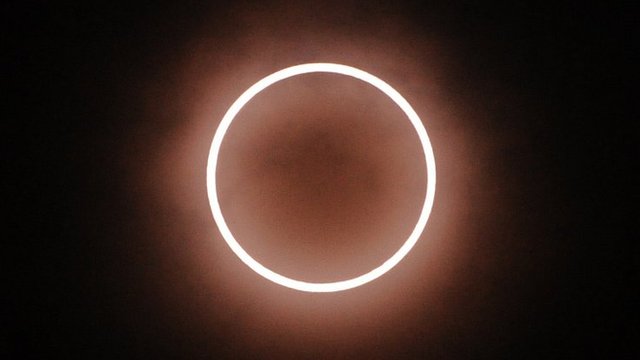
An "annular eclipse" has been viewed across a swathe of the Earth stretching across the Pacific from Asia to the western US.

The eclipse occurs when the Moon is at its farthest from the Earth and does not block out the Sun completely.

Millions of people witnessed the resulting "ring of fire" phenomenon.

The eclipse passed almost directly over Tokyo before sweeping just below Alaska's Aleutian islands and making landfall in the western US.

In Japan "eclipse tours" were held at schools and parks, on pleasure boats and even private airplanes. Similar events were also held in China and Taiwan.

TV in Tokyo broadcast the event live.

Light rain fell on Tokyo as the eclipse began, but the clouds thinned as it reached its peak, providing near perfect conditions.
Children in Kawakaki, Tokyo Schoolchildren in Tokyo enjoyed the phenomenon

"It was a very mysterious sight - I've never seen anything like it," said Kaori Sasaki, who joined a crowd in central Tokyo.

Japanese electronics giant Panasonic sent an expedition to the top of Mount Fuji to film the eclipse using solar-powered equipment.

"Our goal is to broadcast the world's most beautiful annular eclipse from the highest mountain in Japan," the company said.

However, in Hong Kong skywatchers were not so lucky. Hundreds had gathered along the Kowloon waterfront where the Space Museum had set up solar-filtered telescopes, but heavy clouds obstructed the view.

In the US, viewing parties were reported in Reno, Nevada; Oakland, California, and elsewhere.

Hundreds also travelled to the Petroglyph National Monument in Albuquerque, New Mexico, which was hailed as one of the best vantage points.

"That's got to be the prettiest thing I've ever seen," said Brent Veltri of Salida, Colorado.

The eclipse was fully visible across a 240 to 300km-wide swathe but partial views could be seen across much of east Asia and North America.

Source : BBC


© Copyright Maxy Zone 2010 -2011 | Design by Menikge | With Games Rise | Powered by Blogger.com.